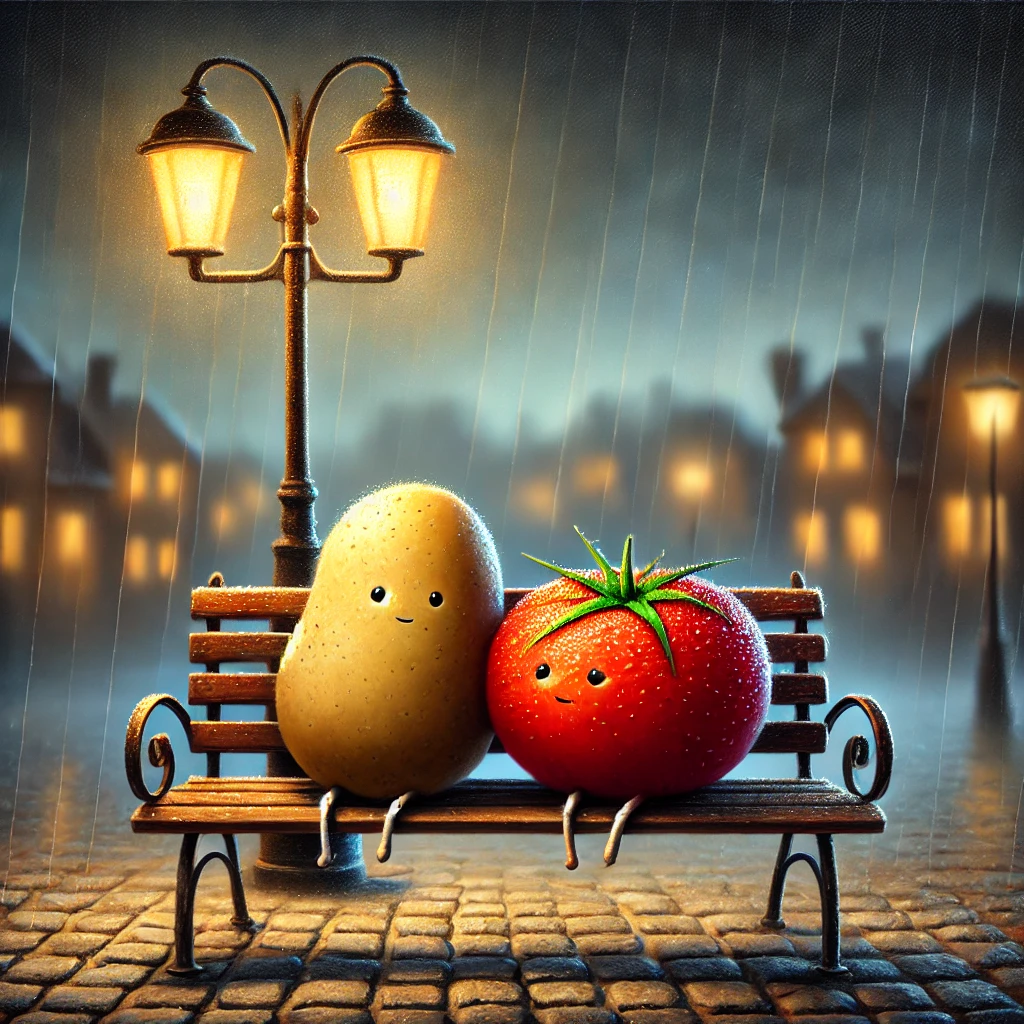
(A Festive Error in Several Acts)
The Universe, Briefly Explained and Immediately Misunderstood
In the beginning, there was dirt.
Not metaphorical dirt. Not symbolic dirt. Real dirt. Moist, granular, and proud of its minerals.
Inside this dirt lived a potato.
The potato had no name because names require witnesses, and none cared enough to perform the ceremony. The potato did not resent this. It merely existed, which it did with considerable effort. Existing, after all, requires patience, and patience is a root vegetable’s most aggressive virtue.
Above the dirt, the universe unfolded as it always had. Not with stars or galaxies or divine proclamations, but with onions arguing quietly with themselves, cabbages attempting philosophy and failing, and carrots practising optimism like a muscle they refused to stretch.
There were no humans in this universe. None had ever existed. The idea of humans would later be invented accidentally by a turnip during a fever dream and immediately dismissed as unrealistic.
The potato sensed that something was wrong.
Not wrong in a catastrophic way. Wrong in a seasonal way. The dirt felt tense. The worms were humming out of tune. Somewhere far away, bells were ringing, though bells did not exist either.
It was almost Christmas.
The potato did not know what Christmas was.
This made it furious.
On the Suspicion of Cheer
The potato emerged from the soil one afternoon with the confidence of something that had absolutely no plan. Snow fell gently around it, though snow resented being described as gentle and preferred words like inevitable or quietly judgmental.
Everywhere the potato looked, vegetables were behaving incorrectly.
A beet was wearing tinsel.
A parsnip was wrapped in lights and blinking Morse code that translated roughly to “HELP.”
The broccoli forest nearby glowed with ornaments made of hardened sap and lies.
“What is happening?” the potato asked no one.
A radish skidded past screaming joy.
Joy was illegal in January. Everyone knew that.
“Why are you like this?” the potato demanded of the radish.
“It’s Christmas!” the radish shouted, before slamming into a snowbank and apologising to it.
The potato felt a stirring in its starch. Suspicion rose like gravy without consent.
Christmas. The word echoed through the potato’s mind like a dropped spoon in an empty kitchen that had never existed.
“What is Christmas?” the potato said aloud.
No one answered. This was typical.
A Festive Lie Reaches Critical Mass
The potato walked. Walking is an ambitious word for what potatoes do, but ambition is mostly branding.
As it travelled, it observed traditions unfolding with the energy of vegetables that had not thought things through.
A pumpkin choir sang hymns to an undefined concept called “Warmth.”
Corn stalks exchanged gifts they had stolen from each other earlier that morning.
A solemn leek carved a star into the ice and then immediately forgot why.
The potato approached an elder vegetable, an ancient yam whose wrinkles suggested deep wisdom or an untreated condition.
“What is Christmas?” the potato asked again, louder this time, in case the universe had simply missed it earlier.
The yam sighed, a sound like dry leaves surrendering.
“Christmas,” said the yam, “is when we pretend things are better than they are and then punish ourselves for believing it.”
“That sounds inefficient,” the potato replied.
“Yes,” said the yam. “But it comes with lights.”
The potato considered this.
The lights were suspicious. Anything that required electricity in a universe without physics was deeply untrustworthy.
“And why is everyone doing it?” the potato asked.
The yam looked up at the sky, where a carrot-shaped constellation blinked nervously.
“Because everyone else is,” the yam said. “And because once, long ago, something warm happened during winter and we have been trying to recreate the error ever since.”
This did not satisfy the potato.
Nothing ever did.
The Potato Attempts Theology and Fails Gracefully
That night, the potato sat beneath a tree that was aggressively festive. The tree had decorated itself and now demanded praise.
Lights flickered. Ornaments reflected the potato back at itself, rounder and more confused.
“If Christmas exists,” the potato reasoned, “then it must have rules.”
The universe laughed quietly, like celery snapping in the distance.
The potato began constructing a philosophy.
Christmas, it decided, was either:
- A ritual sacrifice disguised as cheer
- A collective hallucination brought on by the cold
- A marketing scheme invented by pine trees
- All of the above, and also soup
The potato rejected option four because the soup implied purpose.
Still, something tugged at it. A feeling like nostalgia, though nostalgia requires memory, and the potato had only ever known dirt and disappointment.
Why decorate, it wondered, if nothing was being celebrated?
Why give gifts if nothing was being forgiven?
Why sing, if no one was listening?
These questions floated upward and froze, forming icicles of doubt.
The potato hated them.
The Advent of the Vegetable Council
The Vegetable Council convened annually to address matters of urgency, such as rot, frost, and the existential threat posed by zucchini.
This year’s agenda had only one item.
CHRISTMAS HAS GOTTEN OUT OF HAND
The potato was summoned accidentally. It sat in the council chamber, which was a hollowed-out squash with delusions of grandeur.
Around it gathered representatives of every crop.
The Onion Wept Immediately.
The Spinach Wilted Dramatically.
The Pepper Shouted Without Knowing Why.
“We must decide,” boomed the Turnip Chair, “what Christmas means.”
The potato stood.
“Why,” it said, “must Christmas mean anything at all?”
Gasps. Several peas fainted.
“Meaning,” said the Turnip Chair, “is mandatory.”
“No,” said the potato. “Meaning is optional. Like hats.”
This caused a riot.
A Gift Is Opened That Should Not Be
To prove its point, the potato stole a gift.
This was not difficult. Gifts were everywhere, unattended, glowing with misplaced sincerity.
The potato tore open the wrapping.
Inside was nothing.
Not metaphorical, nothing. Actual nothing. A small, polite absence.
The potato stared into it.
The nothing stared back, somehow smug.
“This,” said the potato, holding it aloft, “is Christmas.”
The crowd murmured.
“That’s not fair,” said a cucumber. “Mine had socks.”
The potato closed the box.
“Christmas,” it declared, “is an excuse to place nothing inside something and pretend the container was the point.”
Silence fell like powdered sugar.
Somewhere, a bell rang, and immediately regretted it.
Snow Begins to Fall Incorrectly
The universe responded poorly to being analysed.
Snow fell upward.
Icicles grew resentful and melted in protest.
A wreath achieved consciousness and filed a complaint.
The potato felt a strange warmth inside itself. Not joy. Not hope. Something worse.
Understanding.
It realised that Christmas was not a belief. It was a malfunction. A seasonal bug in the vegetable mind, triggered by darkness and excessive carbohydrates.
The potato laughed.
The laughter echoed and cracked the ice.
The Ghost of Vegetables Past, Present, and Poorly Planned
As if summoned by narrative necessity, three spirits appeared.
They were all potatoes.
This was unhelpful.
“I am the Ghost of Potatoes Past,” said the first, mouldy and judgmental.
“I am the Ghost of Potatoes Present,” said the second, vibrating with anxiety.
“I am the Ghost of Potatoes Future,” said the third, already mashed.
They circled the potato.
“You must learn the meaning of Christmas,” they intoned, poorly synchronised.
“No,” said the potato. “You must learn the meaning of potatoes.”
The ghosts paused.
This had not been covered in training.
The Potato Refuses the Moral
The ghosts showed visions.
Potatoes sharing warmth.
Potatoes forgiving each other.
Potatoes are becoming soup together.
The potato gagged.
“Stop,” it said. “This is propaganda.”
“But Christmas is about togetherness,” pleaded the Ghost of Present.
“Togetherness,” the potato replied, “is just loneliness with witnesses.”
The ghosts vanished, embarrassed.
An Ending That Refuses to Behave
Morning came. Or something like it.
The snow settled into a shape resembling acceptance.
The vegetables returned to their rituals, quieter now, unsure.
The potato returned to the dirt.
It did not celebrate.
It did not decorate.
It did not believe.
But as it sank into the soil, it felt something unfamiliar.
Not joy.
Not hope.
A small, stubborn warmth.
Not because it was Christmas.
But because it was winter.
And surviving winter, the potato realised, was already enough of a miracle.
The Moral, Immediately Revoked
Christmas continued.
The potato continued not caring.
Both were equally valid.
Somewhere, a turnip invented New Year’s and everyone groaned.
The universe spun on, festive and incorrect.
And the potato, nameless and unwrapped, slept peacefully in the dirt, dreaming of nothing at all.
Which, somehow, felt like a gift.