The potato was first noticed during dinner preparations.
Not the seasoning. That part was normal.
Humans seasoned everything. Salt drifted through kitchens like weather. Pepper arrived dramatically. Butter melted with the confidence of someone who had never doubted themselves for a single second.
No, this was different.
The carrot had opinions.
“I’m just saying,” the carrot announced from the produce basket, “if humans keep calling us side dishes, eventually we’ll start believing it.”
The potato blinked.
Across the counter, a cucumber slowly rolled an inch away from the conversation, the way cucumbers often do when tension appears.
“You can’t start philosophical discussions after sunset,” the cucumber muttered. “That’s how salads become podcasts.”
The carrot ignored this entirely.
“We deserve more recognition,” it continued. “Humans post photos of avocado toast as if it invented civilisation. Meanwhile, potatoes have carried entire family dinners for centuries.”
The potato tried not to look proud.
It failed a little.
The onion, resting nearby in a mesh bag like an exhausted librarian, sighed deeply.
“Recognition is overrated,” the onion said. “Every time humans notice me, someone cries.”
“That’s actually a very strong point,” whispered a mushroom.
Nobody had noticed the mushroom arrive.
Mushrooms had a habit of appearing halfway through conversations as if they’d been there all along, silently gathering emotional data.
The potato looked around the kitchen carefully.
This was unusual.
Vegetables rarely spoke all at once. Most evenings were peaceful. Predictable. There would be quiet reflections, perhaps a minor disagreement involving tomatoes insisting they were misunderstood, and then everyone would settle into comfortable silence.
Tonight, however, felt strangely energetic.
Like the kitchen itself had too much chai.
The carrot hopped slightly closer.
“We’ve been meaning to talk to you.”
The potato froze.
Few sentences in existence had ever improved after those words.
The cucumber rolled another inch away.
“Technically,” it said, “you’ve been meaning to talk. I was drafted into this emotionally.”
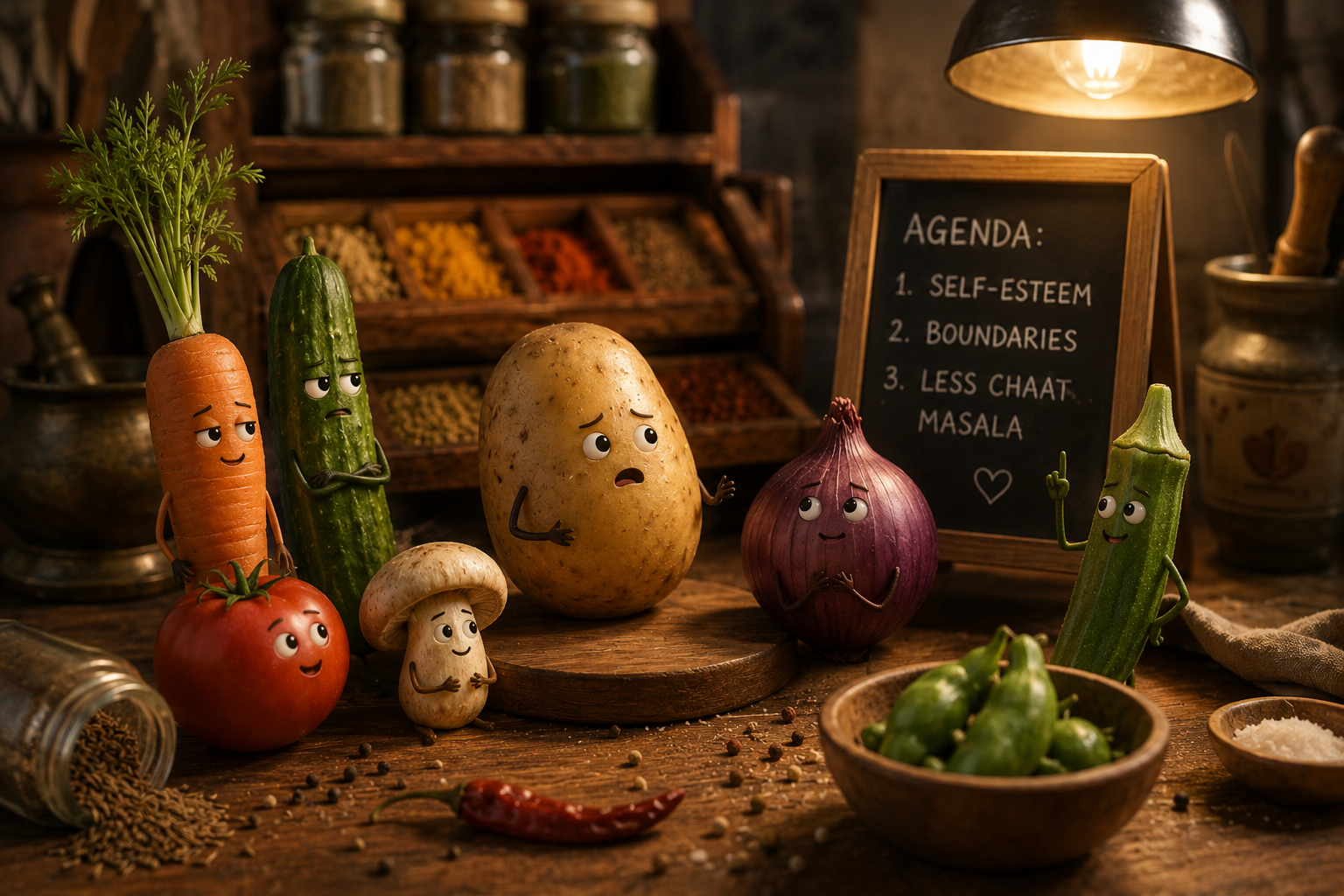
“It’s an intervention,” the carrot explained proudly.
The potato gasped softly.
“For what?”
A dramatic silence followed.
Even the refrigerator hummed with anticipation.
“For your self-esteem.”
The potato stared.
“My what?”
“Your self-esteem,” repeated the carrot. “You keep letting humans season you without questioning it.”
The potato relaxed slightly.
“Oh. That.”
“Yes, that,” said the carrot. “You’re always becoming things for other people. Mashed potatoes. Fries. Chips. Hash browns. You’ve had more identity changes than a celebrity rebranding after controversy.”
“That’s unfair,” the potato replied. “Fries are wonderful.”
“That’s not the point.”
“It’s a very good point, though.”
The onion nodded thoughtfully.
“I would become fries immediately if given the opportunity.”
“You say that because nobody turns onions into the main event,” the carrot replied.
“That’s simply because humans fear emotional complexity.”
The mushroom nodded solemnly, though nobody knew exactly why.
The potato shifted awkwardly on the cutting board.
“I don’t mind becoming different things,” it said quietly. “I like being useful.”
The kitchen softened for a moment.
Even the carrot’s expression lost some sharpness.
The cucumber stopped trying to escape.
Being useful was important to vegetables. Possibly too important.
The okra, who had remained silent until now largely because nobody had realised okra was present, suddenly spoke.
“I once spent three weeks in the refrigerator drawer,” the okra said. “Do you know what humans called me afterwards?”
Nobody answered.
“Sticky.”
A respectful silence followed.
“That sounds difficult,” said the potato.
“It changes you,” the okra replied darkly.
The carrot cleared its throat dramatically, eager to regain control of the meeting.
“The point is,” it continued, “you don’t always have to absorb what’s given to you.”
The potato looked down at the scattered grains of salt still resting on the counter from earlier.
“I don’t know how not to.”
Nobody spoke for a while after that.
The refrigerator hummed again.
Somewhere in the distance, a pressure cooker released a long emotional sigh.
The mushroom finally stepped forward.
“I think humans do it too,” it said softly.
“Season themselves?”
The mushroom nodded.
“A little confidence here. A different personality there. They adjust constantly depending on who’s nearby.”
The onion sighed.
“That explains social media.”
The cucumber rolled thoughtfully.
“I tried having a personality once,” it admitted. “Very exhausting. I went back to being hydrated.”
“That honestly suits you,” said the potato.
“Thank you.”
The carrot climbed onto an overturned bowl like a motivational speaker preparing for a seminar no one remembered registering for.
“We need boundaries,” the carrot declared.
The potato blinked.
“With seasoning?”
“With everything.”
The carrot pointed dramatically toward the spice box.
“Today it’s chaat masala. Tomorrow, it’s unrealistic expectations.”
“That escalated quickly,” said the cucumber.
“But accurately,” muttered the onion.
The potato considered all of this carefully.
It remembered the strange feeling from earlier. That tiny moment before the salt touched its skin. The brief realisation that existing and improving were not necessarily the same thing.
But it also remembered something else.
Family dinners.
Warm kitchens.
The sound of rotis puffing on open flame.
The way humans smiled around comfort food as they’d briefly found shelter from themselves.
“I don’t think seasoning is always bad,” the potato said carefully.
The carrot folded its tiny arms.
“Explain.”
“Well…” The potato hesitated. “Maybe becoming something for others isn’t terrible if you don’t disappear completely while doing it.”
The kitchen went quiet again.
Even the mushroom looked impressed, which was difficult because mushrooms already looked like they knew ancient truths.
The onion sniffed emotionally.
“Sorry,” it said. “Natural reaction.”
The okra leaned dramatically against the fruit bowl.
“That was beautiful.”
“I think,” the potato continued slowly, “there’s a difference between sharing yourself and replacing yourself.”
Nobody interrupted.
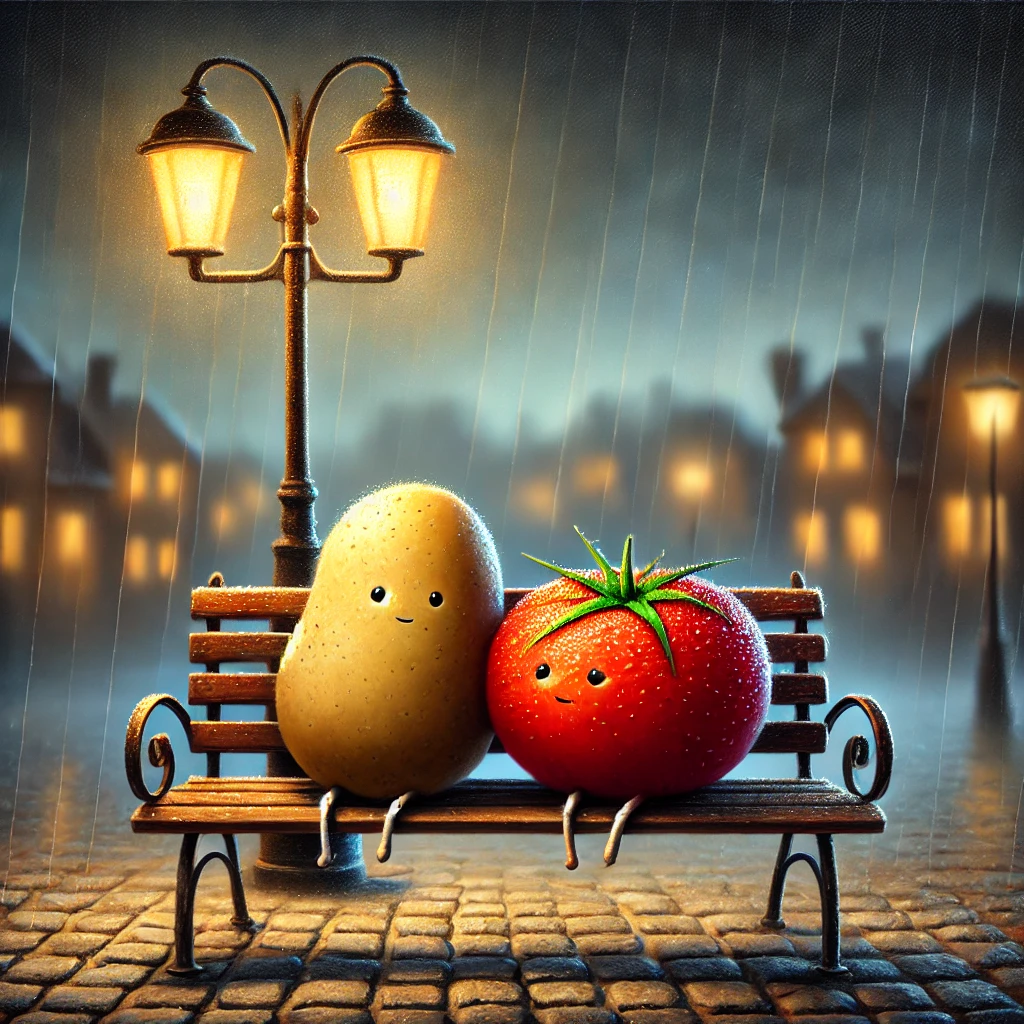
Outside, rain tapped gently against the kitchen window.
The kind of rain that made everything feel briefly thoughtful.
The carrot finally smiled.
“A surprisingly balanced answer.”
“Thank you.”
“I still think you deserve more respect.”
“That’s fair.”
“And less chaat masala.”
“Absolutely not,” said the potato immediately. “Let’s not say things we can’t take back.”
The cucumber laughed so hard it nearly fell off the counter.
Soon, the others joined in.
Even the onion, though it looked emotional about it.
For a while, the kitchen became wonderfully chaotic.
The carrot passionately argued that soup was just “vegetable hot tub culture.”
The mushroom claimed to understand the moon on a personal level.
The okra kept describing itself as “texturally misunderstood.”
And the cucumber, despite repeated objections, somehow ended up halfway inside a steel tumbler.
The potato laughed harder than it had in a long time.
Not because everything suddenly made sense.
But because maybe things didn’t need to.
Sometimes it was enough to sit among friends while rain touched the windows and the world smelled faintly of cumin and frying onions.
Sometimes it was enough to be a potato.
Seasoned or not.