A Countertop Chronicles story
The rain returned three nights after the Great Chaat Masala Scandal, which felt unnecessary to the potato, because the kitchen had only just begun pretending it was normal again.
The house was asleep. The stove had cooled. The pressure cooker sat on its burner with the calm exhaustion of someone who had already done the difficult part of the evening. Near the spice box, chaat masala remained inside its tin, quieter than usual, which made everyone suspicious in a way that was beginning to feel almost affectionate.
By midnight, the kettle had begun to sigh.
Not the ordinary kettle sigh, the one that came from cooling metal and unresolved steam. This was slower. Personal. The sort of sigh that made the onion look up from his invisible notebook.
“She is thinking about companionship again,” the onion said.
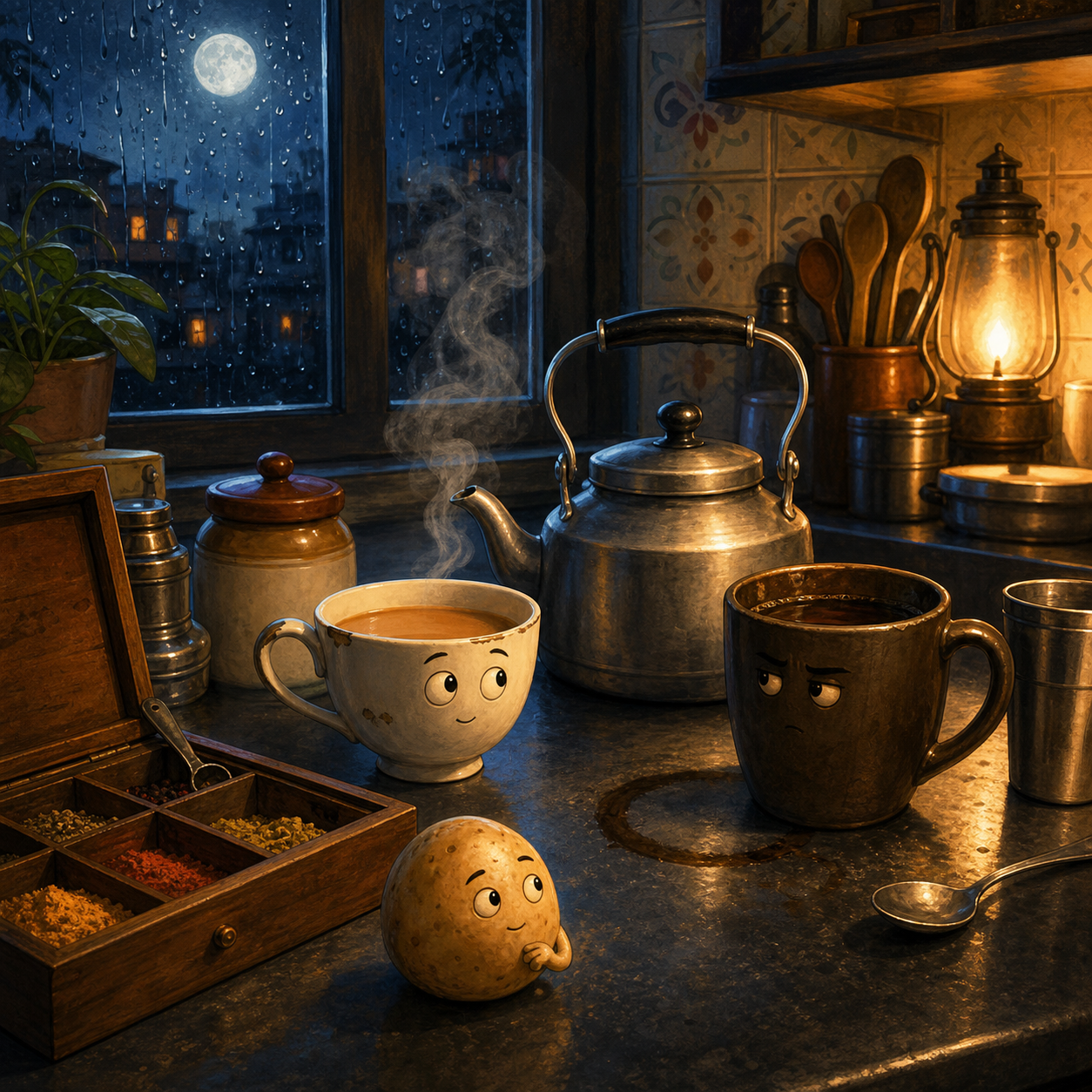
On the counter, two cups had been left by the humans before bed. One held the faint brown memory of tea, gentle around the rim. The other smelled sharply of coffee, dark, alert, and far too certain of itself. Between them lay a spoon, a sugar jar, and the kind of silence that arrives when something private is about to become everyone’s business.
The kettle watched the cups carefully.
“I only think,” she said, “that a person should not have to pour themselves endlessly into those who do not know how to receive warmth.”
No one replied at once.
This was the trouble with the kettle. She spent most of the day being practical, but at night she became accurate.
Tea had been meeting Coffee every evening near the edge of the counter. At first, the kitchen found it charming. Tea was steady, warm, familiar in a way that made rainy evenings feel less like weather and more like permission. Coffee was quick, intense, full of declarations. He spoke of energy, purpose, late nights, big plans, and leaving stains wherever he went as though this were proof of impact.
For a while, Tea liked this.
There was something flattering about being chosen by intensity. It made ordinary warmth feel suddenly cinematic. Coffee did not simply arrive; he entered the cup as if beginning a revolution. He promised alertness. He promised transformation. He promised that no one who stayed close to him would ever feel dull again.
But then came the small things.
Coffee arrived late and called it timing. He left rings on the counter and called them memories. He made Tea feel calm in comparison, then treated calmness as a lack of personality. When Tea cooled, he said she had changed. When Tea stayed warm, he said she was too available. If she asked where he had been, he claimed mugs needed freedom.
Tea said little after that, and that worried the kettle most. There is a difference between quietness that comes from peace and quietness that comes from measuring every word before it is misunderstood.
That night, Tea finally asked him a question.
“When I am tired,” she said, “do you stay?”
Coffee gave a small laugh, the sort that tried to sound charming before it became an answer.
“Tiredness is a mindset.”
The spoon made an involuntary clink.
Tea tried again. “When you hurt me, do you notice before I explain?”
Coffee’s surface trembled, reflecting the window, the rain, the cupboard, everything except himself.
“I think,” he said finally, “you are becoming too sensitive.”
The kitchen did not gasp. It became still in a deeper way.
The potato had heard humans speak like this near phones left charging on the counter. Soft voices at midnight. Long pauses. Someone saying they were fine in a tone that meant they had already begun leaving from the inside. The potato had never understood dating, but he understood the danger of someone who made you explain pain as though it were a hobby.
Tea did not break. That seemed important. She only cooled a little.
Across the counter, the old steel tumbler cleared his throat. He had belonged to the house longer than most of them. He carried tea, water, buttermilk, sometimes coffee when the humans were desperate, and he had never once claimed this made him mysterious.
“Warmth should not have to audition,” he said.
Everyone turned to him.
“Some people arrive like boiling,” the tumbler continued. “They make everything feel urgent. You mistake the noise for care because it fills the room. But reliable people are not always loud when they enter. Sometimes they are the ones who remember how you take your sugar. Sometimes they wait until you are ready. Sometimes they do not make your nervous system prove it is alive.”
Coffee shifted in his mug. “So I am the villain now?”
“No,” said the potato. “You are the warning.”
This was harsher than the potato intended, but not less true.
Without an audience for his intensity, Coffee seemed smaller. Still dark, still fragrant, still capable of waking a person too quickly, but no longer mistaken for depth simply because he was difficult to ignore.
The kettle moved closer to Tea.
“You are allowed to want someone dependable,” she said.
Tea looked down at herself. Her surface had gone pale, but there was still warmth in her. Not the dramatic kind. The survivable kind.
“I thought dependable meant boring,” she said.
The cucumber, who had spent most of his life trying not to be selected for anything, spoke with unusual care.
“No. Boring is when nothing changes. Dependable is when something does not disappear the moment change becomes inconvenient.”
By then, the rain had softened. The kitchen seemed less like a place where a verdict had been reached and more like a place where someone had finally named the right thing.
Coffee remained on the counter until morning, cooling into himself. No one mocked him. That would have made it too simple. Wrong people were not always monsters. Sometimes they were only careless people with good lighting and excellent timing. That was part of the peril.
Tea spent the rest of the night beside the kettle and the steel tumbler. They did not advise her constantly. They did not turn her pain into a group project. They simply stayed close enough that she did not have to wonder whether warmth was something she had imagined.
Near dawn, the potato rolled back toward the fruit bowl.
Chaat masala’s tin opened slightly.
“For the record,” it said, “I was not involved.”
“No one accused you,” said the onion.
“Yes,” said chaat masala. “I am healing from that.”
Outside, the rain stopped.
Inside, the kettle held the last of her warmth without rushing to pour it anywhere.