Part of The Potato Builds a Game
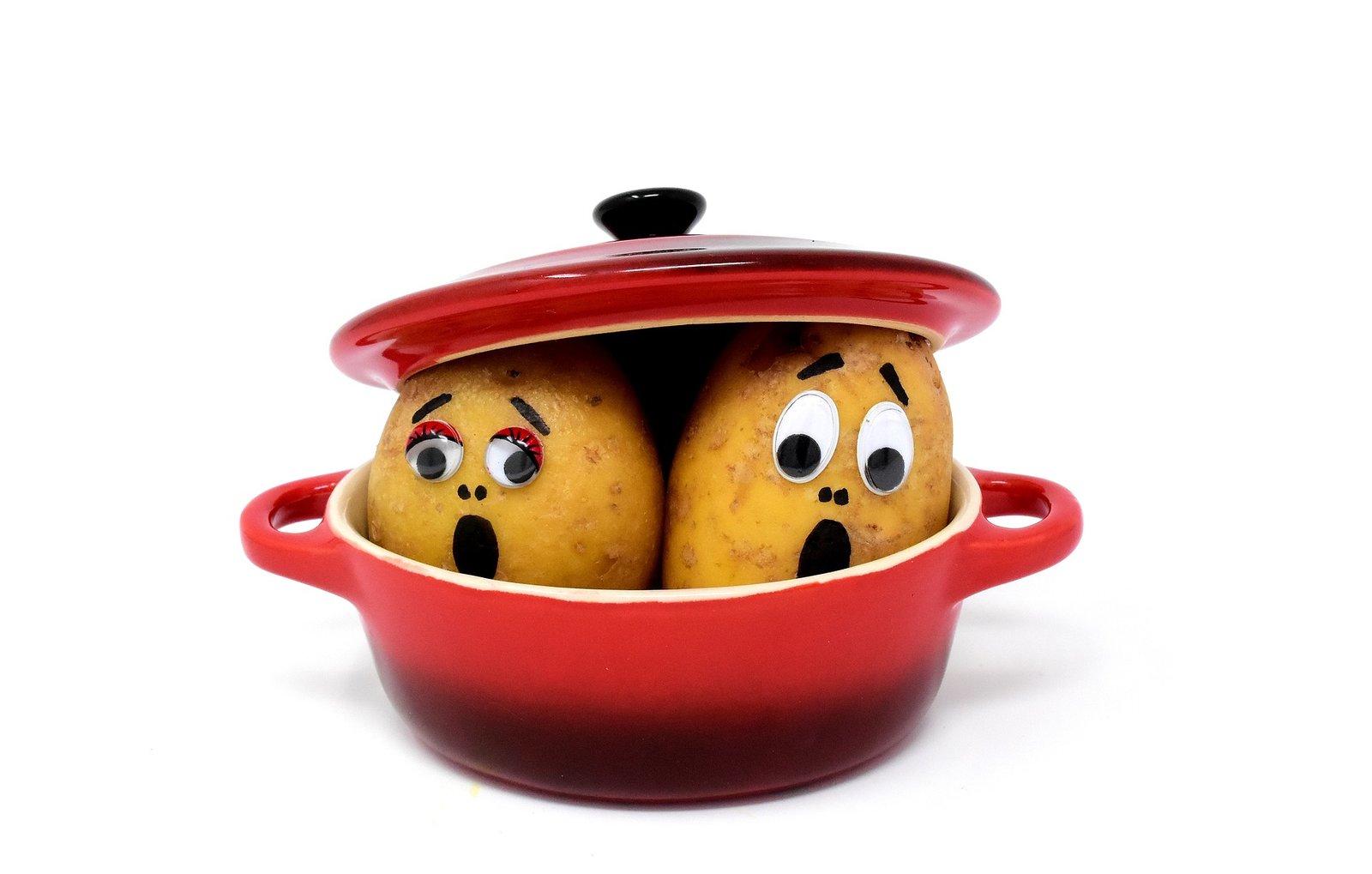
The potato did not plan to become a game developer.
This is worth saying first, because later, when the laptop was open and the project files had started multiplying like unpaid responsibilities, everyone behaved as if this had been inevitable. It had not. The potato had begun with a much smaller problem. He wanted to understand humans.
That was all.
The desire arrived late one night in the kitchen, after the last vessel had been washed and the house had settled into the kind of silence that still contains several pending thoughts. The steel plates leaned against each other in the drying rack. The pressure cooker sat on the stove looking heavy with secrets. The fridge hummed with the dull authority of an appliance that knew everyone’s leftovers and judged them privately.
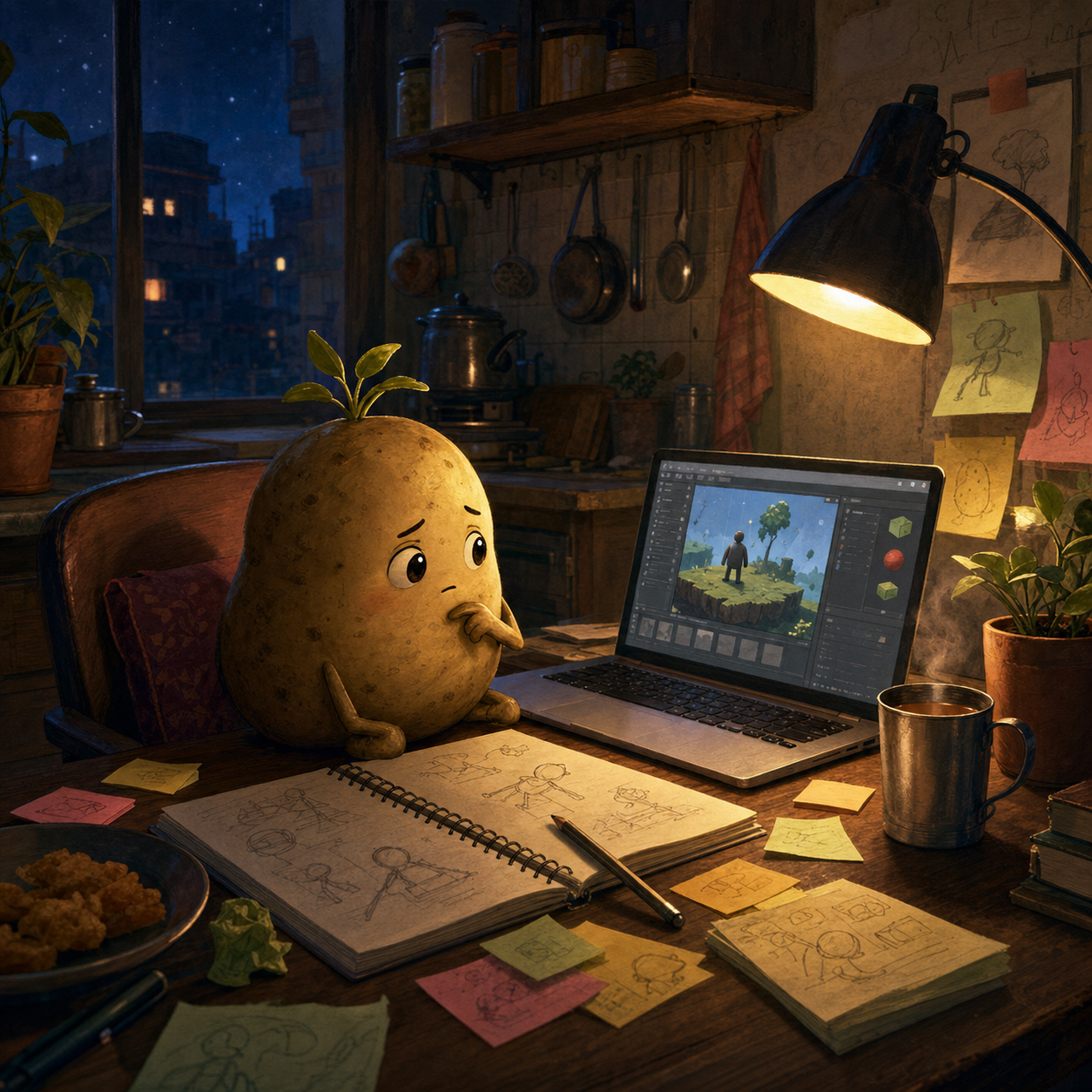
The potato rested near the laptop, which had been left on the table by a human who believed closing tabs was a form of personal defeat.
On the screen was a blank project.
The potato stared at it for a long time.
Blank things have a way of looking innocent. A blank page. A blank canvas. A blank project. They sit there politely, wearing white space like good manners, while quietly asking what sort of person you are prepared to become.
The potato was not prepared to become anyone. He was barely prepared to be a potato with opinions.
Still, humans had become difficult to ignore. He had watched them from baskets, counters, dining tables, and once from the bottom of a shopping bag where a coriander bunch had taken up too much emotional space. Humans entered rooms and immediately forgot why. They said, ‘It’s fine,’ in voices that suggested it was absolutely not fine. They apologized to chairs after bumping into them, then took three days to reply to a person they actually liked.
There was clearly something going on.
The potato had considered studying humans directly, but this seemed dangerous. Humans became strange when watched. They performed productivity near open laptops. They laughed at messages, then reread them with the expression of someone checking for structural damage. They stood near sinks and discovered things about themselves that should probably have been discovered earlier.
So the potato did what many overwhelmed minds do when reality feels too large.
He tried to make a smaller version of it.
A game, he thought, might help. A game could have rooms, choices, consequences, and a potato who slowly learned what humans meant when they said things they did not quite mean. It could hold embarrassment without needing to solve all embarrassment. It could turn confusion into a system, which sounded sensible until one remembered that systems are also where confusion goes to buy furniture.
The laptop asked for a project name.
The potato typed slowly. This was not because he was being thoughtful, though he enjoyed appearing thoughtful when possible. It was because potatoes are not naturally suited to keyboards. Every letter required a small act of commitment.
Spuddenly Human.
The name appeared on the screen.
It was terrible.
It was also correct.
The potato felt a private little warmth, the kind that arrives when a bad idea has enough honesty in it to become a real idea. He imagined a game in which a potato entered the human world and tried to understand emotion, stupidity, kindness, panic, family expectations, group messages, and the human belief that any unresolved situation can be improved by saying, ‘Let’s discuss.’
For a few minutes, the idea behaved beautifully. It had atmosphere. It had jokes. It had a potato in a house full of preventable incidents. The potato leaned back with the satisfaction of someone who had mistaken naming a project for making one.
Then the laptop asked what kind of game it was.
This was rude.
Platformer. Puzzle game. Adventure game. Narrative game. Cozy exploration. Visual novel. Point-and-click. Role-playing game. The words gathered on the screen like relatives at a wedding, each one convinced it understood the situation better than the others.
The potato did not want a game where he jumped on enemies. If a potato became conscious, he felt, its first instinct would not be combat. It would be worry. Possibly observation. Eventually a long internal monologue about why humans keep putting decorative cushions on chairs no one is allowed to sit on.
He did not want a pure puzzle game either. Humans were already puzzles, and most of them came without helpful edge pieces.
For one brave moment he wrote down ‘cozy narrative exploration.’ This sounded gentle and respectable. It also sounded like something a person says before spending four hours wondering why a character can walk through a table but not past a spoon.
The kettle, cooling beside him, clicked once.
‘You are trying to understand humans by building a system,’ it said.
‘Yes,’ said the potato.
‘That is very human.’
The potato looked away from the kettle. There are accusations one is not ready to receive before sunrise.
He opened the game engine.
At first, nothing happened in a highly organized way. There was a viewport, a scene tree, an inspector, several panels, and the quiet impression that the software already knew what it was doing and was waiting for the potato to become less embarrassing. The potato clicked something. A node appeared. He clicked something else. The node became a different kind of node, which felt less like progress and more like a legal complication.
He learned that everything had a position. Everything had a size. Everything had a name. Even emptiness had coordinates. This seemed excessive, but also slightly comforting. The human world rarely labeled its collisions so clearly.
The potato made a player object.
It did nothing.
This was, admittedly, realistic.
He gave it movement. It moved too much. He added collision. It refused to move at all. He created an interaction area, then spent a dignified amount of time discovering that an interaction area does not interact merely because one has named it hopefully.
By the end of the night, the potato had a room, a character, and a toaster. The toaster looked more emotionally stable than anyone else, which worried him.
Still, something had begun.
The game, as he slowly understood it, would not be about becoming human in a grand or heroic sense. It would be about entering a human home and noticing the small collapses. A message sent to the wrong group. A plant knocked over in a corridor. A leak in the laundry room. A blackout. A potluck, which humans treat as community until someone brings the wrong container.
Each incident would ask the potato what he thought people needed. Curiosity. Responsibility. Attachment. The answers would not announce themselves. They would collect quietly, the way real choices do. Humans rarely know what a moment is doing to them while it is happening. They find out later, usually while rinsing a cup.
The potato liked that.
Then came the documents.
At first, he resisted them. A story bible sounded too official. A voice guide sounded like something written by a committee of spoons. A choice matrix sounded like a spreadsheet had learned to threaten. But the project kept asking questions, and the potato kept needing answers that did not change every time he became tired.
What does this character sound like?
What does this choice remember?
How many words fit in a dialogue card before the player begins spiritually leaving?
Where does the shadow touch the floor?
Why is the potato sliding across the trailer like a guilty sticker?
That last question came later, but it was important.
The trailer looked fine until someone actually looked at it. The potato appeared in the room, but not of the room. He moved from one side to another with the smoothness of an object being dragged by invisible office software. The music had a sound in the middle that behaved like a clap and startled the whole mood. The title appeared too often, as if worried nobody had believed it the first time.
So the potato learned another part of making things: everything that looks finished from far away becomes unfinished when you care enough to inspect it.
He added shadows. Reduced movement. Changed timing. Removed the loud sound. Moved the title to the end. Made screenshots. Wrote notes. Then wrote notes about the notes, because game development is where enthusiasm goes to become folder structure.
There were other problems. The sandbox refused to behave. The tools needed tools. The game needed a way to inspect hidden choices because apparently even the potato’s emotional system required a debug overlay. The build needed reports. The collisions needed auditing. The story needed to remember things without becoming a cupboard full of unlabeled containers.
Each problem arrived pretending to be the end of the project. None of them were. They were only tasks wearing dramatic clothing.
By dawn, the laptop was still open. The project was not finished. It was barely even a game in the way people mean when they say game and expect something that can be played without first apologizing to the engine.
But it existed.
That mattered.
The potato looked at the project name again.
Spuddenly Human.
Still terrible. Still correct.
Outside, the morning began arranging itself behind the window. Inside, the kettle had gone quiet. The kitchen waited with the patience of rooms that have seen many ideas survive their first foolish night.
The potato opened his notebook and wrote one line.
Make the game.
Then, after a pause, he added a second line, smaller and more honest.
First, learn what a node is.