The Potato Builds a Game | Finale, Part One
The potato had finished the game three times before he finished the game. The first time, he had reached the rooftop and watched the ending appear, which seemed a reasonable definition of finished until he tried returning to the kitchen. The second time, every room worked beautifully provided he visited them in the order in which he had built them, an arrangement he felt strangers might resist. The third time, he closed the laptop, announced that the work was done, and remembered a small thing while washing a cup. The small thing became a list. The cup remained unwashed for some time. Now there was a fourth finish sitting on the screen, and he was approaching it carefully, as one approaches a pressure cooker that has stopped making noise without explaining why.
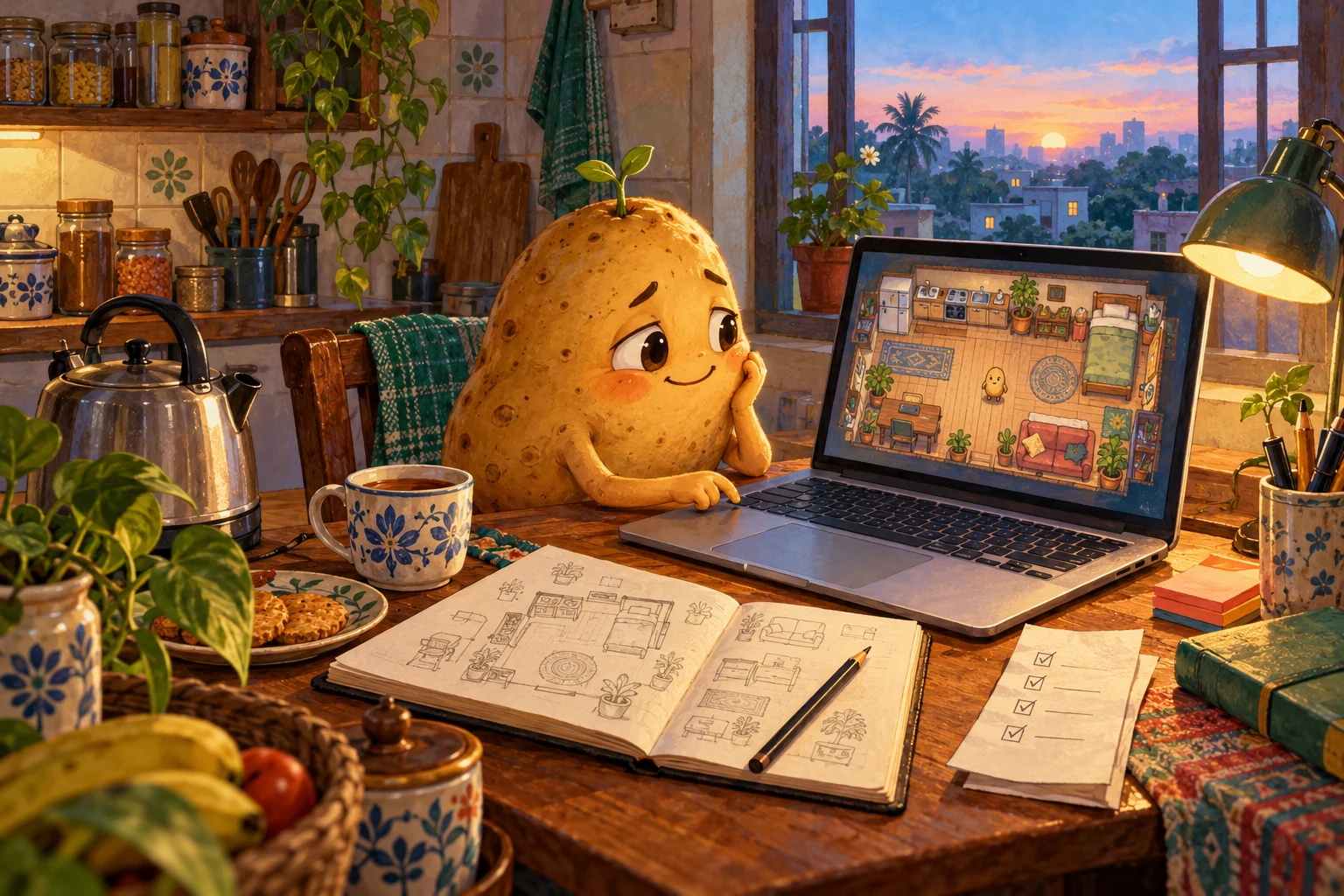
Around him, the kitchen had continued being a kitchen throughout the entire development process. The fridge still made its slightly dissatisfied noise. A steel container still had the wrong lid because someone had decided that matching things was a problem for the future. The kettle stood near the socket, keeping the potato company without requesting a roadmap. On the desk lay his original notebook, open to the page where he had written, with the confidence available only to the uninformed, that he wanted to make a small game about understanding humans. He had underlined small. Below it, in increasingly cramped handwriting, were rooms, choices, saves, sound, mobile controls, endings, and several arrows that now pointed at nothing. The potato considered tearing out the page, then decided it deserved to remain as evidence.
There had been a time when making one room felt like building a universe. He remembered moving his little character across the floor and being delighted enough to forgive the fact that it could enter the dining table. The toaster had stood patiently in the corner while the interaction prompt appeared somewhere closer to a philosophical suggestion than an actual appliance. Those early rooms were rough, but he knew every patch of them. He knew where to stand, which object to click, and which pause meant the engine was thinking. He had quietly become the ideal player for his own game. This was helpful during development and deeply suspicious during testing. An ideal player, he had begun to realise, was often simply someone who already knew where the mistakes were buried.
Eventually, the rooms had become an apartment building. A fallen plant demanded attention; a laundry room acquired more water than anyone had ordered; the lift introduced the possibility of arriving nowhere. There was a blackout, a message that should have stayed in a smaller conversation, and a collection of residents whose intentions were better organised than their actions. Twelve case files gathered across three acts, each one giving his small potato another opportunity to inspect the mess, do something useful, or stay with someone having a difficult evening. It had taken a surprising amount of work to make these choices feel casual. A loose plug could be drawn in an afternoon. The reasons people refused to admit they had left it loose required considerably more thought.
The potato had expected writing to be the comfortable part. Words, at least, did not usually require collision shapes. Then he discovered how differently a sentence behaved inside a small dialogue card, particularly when a player was waiting for the next thing to happen. A paragraph he enjoyed in his notebook arrived on the screen looking like a notice issued by the housing society. He cut it, mourned it, and cut it again. Sometimes the shorter version was funnier. Sometimes he had removed the part that let the joke breathe and had to put it back. He learned to read conversations aloud while the kettle cooled beside him, looking for the point where someone started sounding as though they had been appointed to explain the game. That was usually where the conversation needed another pass.
The building also needed to remember what happened inside it. The potato had originally hoped a few choices would look after themselves, perhaps out of gratitude for being written. Instead, he gave the game a place to keep its chapter, its decisions, its small callbacks, and the consequences that would matter later. He named the system StoryState, a plain name for something carrying a fair amount of emotional baggage. There were three approaches taking shape beneath the story: inquiry, stewardship, and kinship. He liked that a player could gradually lean toward one without being stopped in the corridor and awarded points for being a particular kind of person. The decisions could leave a pattern. The rooftop could notice it when the time came.
He still had to check whether that pattern made sense. This led to the Branch Inspector, which let him look at the choices the game had actually recorded instead of the choices he sincerely believed it had recorded. A Chapter Launcher saved him from repeating the opening every time the laundry room behaved oddly. An Ending Simulator let him try different histories, including the indecisive ones that refused to choose a neat winner. The Collision Audit outlined furniture and interaction areas in bright colours, turning an ordinary room into a diagram of everything trying to stop a potato from approaching a lamp. The kettle watched these tools accumulate. It had lived beside humans for years and recognised the practice of building a second apparatus to understand what the first apparatus was doing.
For a while, the potato regarded every blocked interaction as a personal insult. An object would sit there in plain view, practically asking to be examined, while his character shuffled beside it like someone trying to join a conversation at a wedding. The fix often involved moving something a very small distance. This did not make it less important. A player who could not reach a clue would not know that a carefully planned emotional consequence waited behind it; they would know only that the game had made a promise with its picture and failed to keep it with its controls. He moved props, checked approach spaces, and tried again from the other side. He stopped defending a room because it looked lovely. Lovely rooms also had to let visitors use them.
The art had its own ways of making him start over. In the beginning, he had been pleased whenever a potato appeared on the screen at all. Later, he noticed when it appeared to be floating a short, socially awkward distance above the floor. Shadows helped. So did getting the size right, putting furniture where its drawn feet suggested it stood, and ensuring that a repaired incident looked repaired. He had spent too long with those rooms to treat the changes as decoration. If a player had helped clean up a problem, the room ought to carry some sign of the effort. Otherwise the building would resemble one of those people who accepted help generously and remembered it selectively. He felt there were already enough of those outside the laptop.
Sound arrived with similar demands. A room needed something more particular than music vaguely agreeing that a game was happening. There were appliances, pauses, small interactions, and incidents that needed to be heard without shouting over the dialogue. He listened to a chapter, then to the same chapter again, then wondered whether the fridge behind him was part of the mix. It was not. A cue that sounded entertaining once became an unwelcome visitor after its fifth appearance. The potato adjusted levels and timing until the building could have a mood without insisting on discussing it constantly. He also learned to check what happened when a browser lost focus and came back. Returning to a room should not require two copies of its music competing for the lease.
Then the game had to fit somewhere smaller than his desk. On a phone turned sideways, the apartment still needed to leave room for fingers, dialogue, and a potato trying to get past a chair. A button that seemed generous on his monitor became considerably less generous under a thumb. Text needed room to grow; prompts needed enough contrast to be found; motion needed an off switch for people who did not enjoy being gently moved about by software. He added settings and checked whether the game remembered them. The potato had no wish to make someone request the same accommodation every time they returned. He tested the smaller view again and found himself studying margins with an attention he had previously reserved for ingredients nearing their expiry date.
Saving sounded boring until he thought about losing an evening. He imagined someone closing the game to answer the door, deal with dinner, or simply stop being available to a screen. When they returned, Continue ought to mean continue. The building needed to remember the room they had reached and the choices they had made, even when the potato himself was not there to explain. He checked reloads, old saves, damaged saves, and the fresh start that must actually be fresh. Some of the most reassuring work left no visible scene behind it. It meant a player could leave without being punished, which struck him as a fairly decent thing for a small apartment building to offer.
By this point, his testing notes had developed the firm, unromantic tone of a vegetable who had been disappointed by a door too often. Start again. Reach the object. Leave the room. Come back. Check the choice. Try the ending with a different history. There were automated checks as well, running through routes and resources with a patience he could not reliably produce after midnight. He liked a passing report, but he still opened the build. The reports could tell him that the pieces met their rules; he wanted to see whether a sentence arrived at the right moment, whether the floor felt crowded, whether the game gave him enough time to notice something. The kettle offered no opinion on this. It was busy doing the same simple task properly, as it had been doing for years.
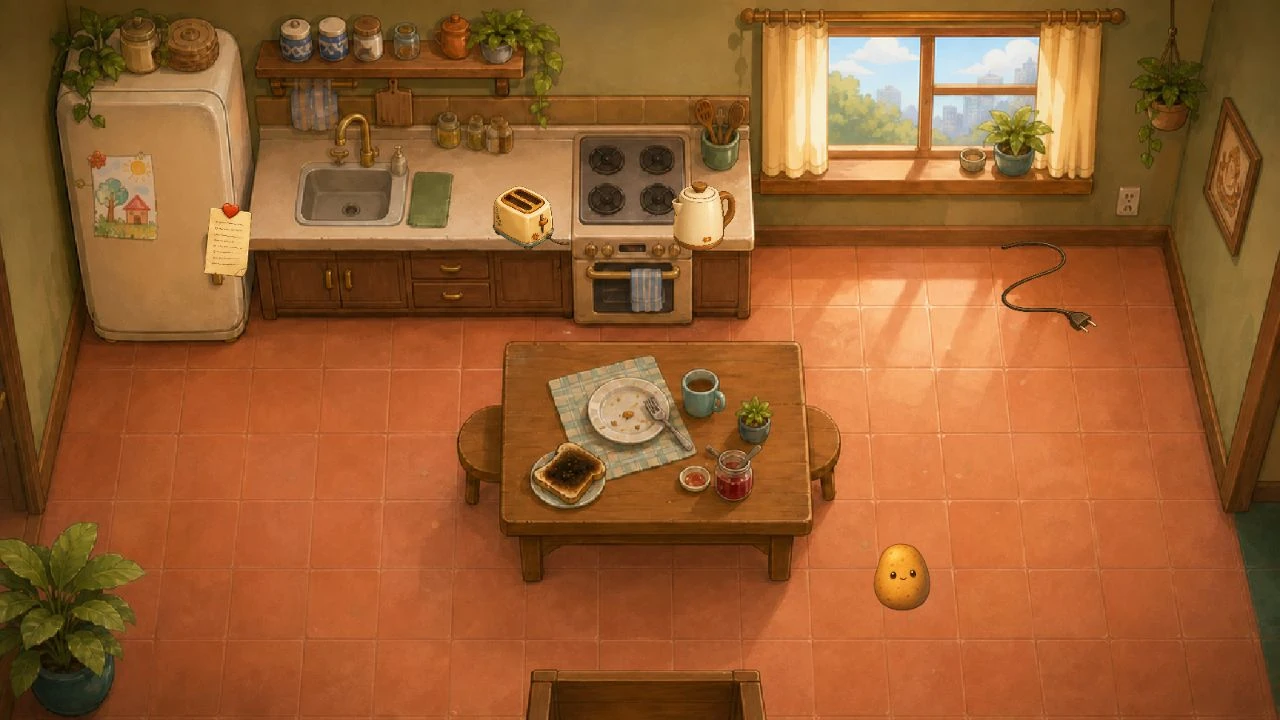
The finished version had a title screen, a beginning, twelve cases, and three earned epilogues. It also had a downloadable Windows build, a browser version, an Emotion Journal, and the sort of folders the potato had once believed happened only to other people. Seeing it all together felt different from seeing each piece work separately. He could start at the beginning and reach the rooftop without reaching for the editor. The little character kept going, small and curious amid the residents' preventable disasters. He had spent so long examining the joints that he had almost forgotten the shape of the thing. For one complete playthrough, he let himself follow the story. Afterwards he added a note about a prompt, because he remained himself.
There was still the matter of allowing somebody else to find it. The itch.io page needed a description that said what the game actually offered, screenshots that showed its rooms, and a trailer that could leave before becoming a second game. He found himself writing about the project as though it belonged to a vegetable he had met recently. A narrative adventure. A field guide to human nonsense. A newly aware potato in an apartment building. These descriptions were accurate, but they barely conveyed the number of cups that had gone cold beside the work. That was probably for the best. Nobody should have to read a complete account of the developer's tea losses before deciding whether to press play.
The potato checked the files one more time. He checked the page, the links, and the version, trying to avoid the human custom of sending the wrong attachment with tremendous confidence. Then he sat still. For months there had always been a useful reason to postpone this moment: a room that needed rebuilding, a conversation that dragged, a saved choice that did not survive the journey. The useful reasons had grown fewer. He could still make changes, of course. He could make changes until the kettle became an antique. But the complete story was there, and he was beginning to suspect that his newest concern, whether absolutely everyone would understand it, did not belong on a bug list.
He told the kettle he thought the game was ready. The kettle asked whether it worked. He said it did, explaining the tests with considerably more detail than a kitchen appliance had requested. The kettle asked whether someone could play it without him standing beside them, muttering directions. He considered this, then said yes. There was a small silence, followed by the click of cooling metal. It was an ordinary sound, but the potato found it helpful to imagine it meant approval. He moved his hand toward the trackpad. Somewhere on the stove, the pressure cooker continued looking as though it knew something he did not.
He pressed publish. The page changed, politely and without any sense of occasion, and Spuddenly Human had an address other people could visit. The potato waited for the kitchen to recognise the achievement. The fridge hummed; a neighbour shut a window; the wrong lid remained on the steel container. He laughed, quietly at first, then enough to startle himself. After all those rooms and all those checks, releasing a game turned out to involve a very small movement followed by having no idea what would happen next. He opened the public page and looked at it for a while. Then he finally washed the cup. It seemed reasonable to begin his new life as a published game developer by reducing the number of unfinished things in the sink.
The finale continues with Part Two: The Potato Who Left the Door Open, arriving 13 October 2026 at 7:00 p.m. IST.
Play Spuddenly Human on itch.io in your browser, or download the Windows version.
Follow The Potato Builds a Game trail, or return to the story where it began.