The Potato Builds a Game | Finale, Part Two
The morning after the game went out into the world, the potato woke with the feeling that he had forgotten to do something. This had become such a reliable part of his routine that he almost found it comforting. He reached for the notebook, saw the last release checklist, and remembered that its boxes were already marked. Outside the window, someone was moving a bucket with the confidence of a person certain that everyone else should be awake. The kettle stood exactly where he had left it. The laptop was closed, an unusual condition that made the desk look as though its owner had gone away. He opened it to check whether the game was still there. It was. Apparently publishing did not require him to keep watching the page, though he intended to investigate this further.
He visited the itch.io page again and pressed Run game. For weeks he had opened builds to find something wrong; now he wanted to see what a visitor would see. The loading screen appeared, followed by the title and the first room. There was his little potato, awake in a building whose appliances and inhabitants were about to make the day unnecessarily interesting. He knew what waited farther up the stairs, but the character did not. That difference had always been there. It felt larger now that someone else could cross it. He watched the opening without advancing immediately, allowing the small potato a little more time before the building began asking things of him.
The strangest part was that the developer could not go along. He could send a link, explain the controls, and make sure the game worked. He could not sit invisibly beside every visitor and say that a particular joke would make more sense in the next room. Somewhere, someone might examine the wrong object first. They might miss a detail he loved, take a route he used mostly for testing, or close the tab because lunch was ready. He found himself wanting to defend the game against these possibilities, then noticed that most of them were simply what playing looked like. The rooms had been built for wandering. It would be a little unreasonable to object when wandering occurred.
While he was making it, the project had given his days a shape. There was usually something he could point to at night: a working interaction, a rebuilt room, a line shortened enough to fit, a piece of music that finally left space for the conversation. Even a disappointing session supplied him with a problem to return to. Release introduced a quieter sort of uncertainty. He could no longer mistake every hour spent on the project for an hour spent improving somebody's experience. Refreshing a page did not make its door wider. Checking again did not make a visitor arrive sooner. This was irritating information to acquire after developing a strong refresh habit.
The kettle found him doing it and asked whether the page had changed. He said it might have. The kettle asked whether he had changed it. He said no, but there could be other changes. The kettle allowed this possibility and went back to heating water, which was an activity with a much more dependable relationship between attention and results. The potato looked at the page for another moment, then put the laptop aside long enough to make tea. He discovered he could drink a cup while it was still warm if he stayed beside it. This was an interesting development. He considered entering it in the journal, but the game's journal concerned emotions in an apartment building and his notebook had suffered enough.
He had imagined release would produce a version of himself who understood game development. Perhaps this version would sit upright, use fewer vague file names, and know which settings mattered before opening them. Instead he remained the same potato, with a little more experience and a large collection of specific things he would check sooner next time. He knew to test an exported build rather than assuming the editor spoke for it. He knew that a room could look spacious and still trap a player near the furniture. He knew that the thing that seemed unimportant on a large monitor could become the entire experience on a phone. None of this made him feel especially grand. It made him better at noticing where people might have trouble.
There were things he had enjoyed that he would not have thought to put in the original plan. Making a repaired room look as though somebody had actually helped it was one of them. Hearing a chapter find its own pace was another. He liked the tiny change that let a conversation sound less rehearsed, and the moment a character seemed to have something to do beyond waiting for the potato to approach. These were modest pleasures, difficult to describe beside a release number. They kept returning to him now that the long checklist had stopped occupying all the available space. He had not merely endured the process until a game emerged. He had liked parts of it, even on evenings when he described the entire undertaking to the kettle in language unsuitable for a product page.
The difficult parts looked different from a little distance too. He remembered the early potato sliding across a trailer, visible but somehow unattached to the room. At the time it had felt embarrassing, the sort of mistake that seemed to announce he had no right to be doing any of this. Later it became a problem of shadow, placement, and movement, all of which could be worked on. He had experienced similar transformations with several problems that originally seemed enormous. The blocked clue became an interaction area he could inspect. The inconsistent ending became a history he could test. He could still remember the frustration, but he no longer confused it with evidence that the project should never have existed.
That did not mean he could make the game perfect by continuing indefinitely. He could see possible changes everywhere, including places that now worked and had no particular need to be disturbed. A new line occurred to him while making tea; a different colour suggested itself while he looked out of the window. The temptation was to reopen the entire building and start rearranging it. He knew where this could lead. The game would become a place forever nearly ready, a building with its opening postponed because the caretaker was considering a nicer doormat. He wrote down the ideas and left the released story alone. Actual problems could be fixed. The residents did not need to have their entire lives revised whenever their creator became restless.
He also had to think about what strangers could tell him. If someone found a clue unreachable, he wanted the room, the device, and what they had tried. If a conversation lost their attention, that mattered even if he had enjoyed writing it. Praise would be pleasant, but useful information might arrive wearing less festive clothes. He prepared a way to ask for it without requiring anyone to produce a formal report about their evening. Then he resisted the urge to imagine responses before they existed. It was easy to populate a silent page with an enthusiastic audience or a particularly cruel one, depending on how much sleep he had had. Neither imaginary crowd could tell him whether the prompt beside the lift was clear.
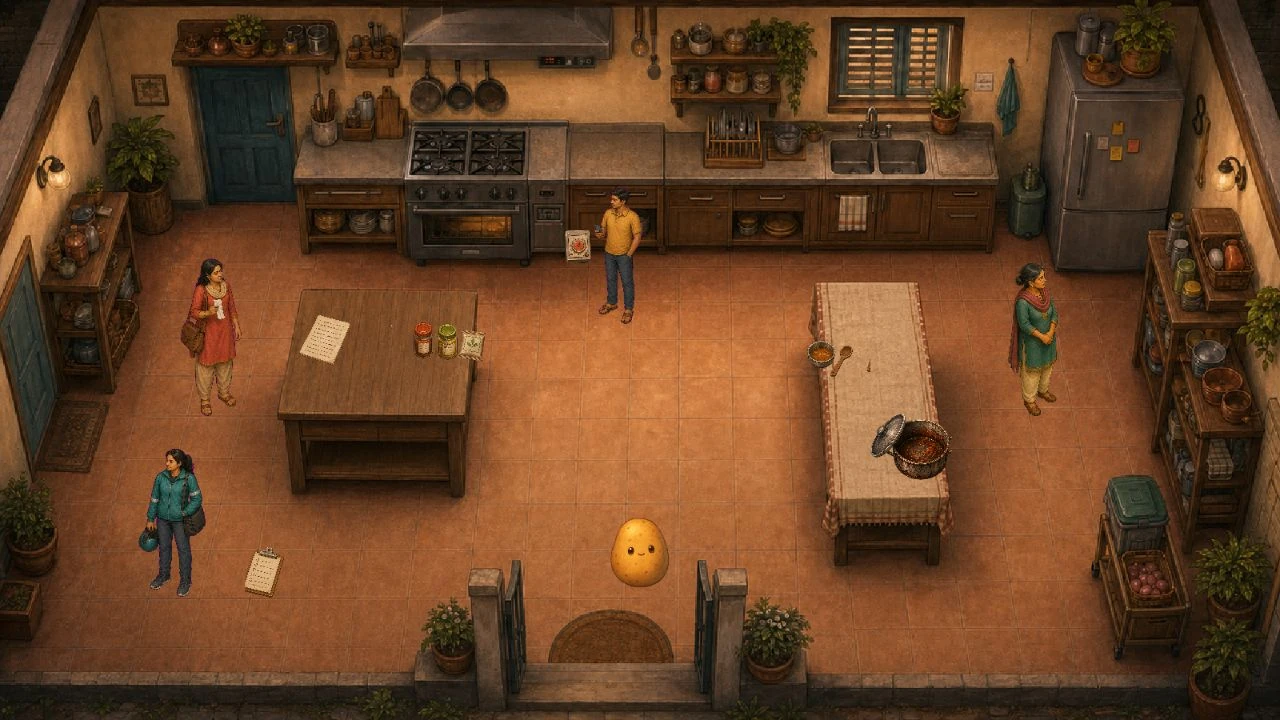
The game was called Spuddenly Human, but finishing it had not made the potato human in any obvious way. He had not acquired shoes, a commute, or the ability to say he was five minutes away while still looking for his keys. He had acquired a browser tab he cared about excessively, which seemed like a start. More seriously, he had become familiar with a few human habits from the inside. He understood how easily affection for an idea turned into fear of showing it. He understood why people kept adjusting a thing that was already useful. He had also learned how much relief lived in a modest, practical kindness: readable text, a remembered setting, a save that let somebody leave and return.
He thought about the three approaches he had given the game. Inquiry noticed what was happening, stewardship tried to put something right, and kinship stayed interested in the people caught inside it. In the building, these could gather into three different answers on the rooftop. At the desk, making the game had required him to borrow from all of them. He had looked closely, repaired things, and worried about whether someone arriving later would feel welcome. He did not need to announce a winning route for himself. There was no epilogue card waiting in the kitchen with a judgement on his work. There was only a mug, a notebook, and an appliance whose main contribution to the project had been remaining available.
He opened the old notebook again. The first page still contained the optimistic small game, underlined as though underlining could enforce a budget. A few pages later was a floor plan that looked like an argument between rectangles. Then came names, incidents, fragments of dialogue, and notes written so late that he could identify the feeling more easily than the handwriting. The evidence was untidy, but it showed something the finished page could not. He had begun without knowing how to do this, and he had continued long enough to make something people could play. He ran a finger along the page and resisted the urge to make a lesson out of it. For a moment, looking was enough.
He could already feel another story trying to enter the room. It had not arrived properly yet; it was mostly a mood, an odd question, and a small incident that seemed likely to become somebody else's problem. A few weeks earlier he would have made a folder immediately, giving the idea a project name before it could object. This time he wrote it down in ordinary pencil. He wanted to allow himself an afternoon without production notes, and perhaps another after that. The kitchen contained plenty to observe while he waited. Two containers had exchanged lids. The neighbour had finished moving the bucket and begun discussing where it should have been moved. The world had not run out of material merely because one game had reached its ending.
Before closing the laptop, he went through the game once more to the rooftop. He would leave the exact answers there for whoever chose to play, but he liked that the building eventually gave its little visitor some space. After all the spills, misunderstandings, repairs, and awkward conversations, there was room to stand still. Beyond the railing, the city carried on with the peculiar business of being full of people. The potato at the desk watched the potato on the screen, each of them having travelled farther than expected from an unremarkable kitchen. He felt fond of the small figure. He also noticed a cloud he might once have spent an evening adjusting. He let the cloud be.
When he returned to the public page, the game was still there. Browser play, a Windows download, a description, and a way for visitors to tell him what they had found. It was a small address on a very large internet, but it was an address all the same. He had spent months trying to make the building behave well enough to receive somebody. Now its door could stay open while he did something else. He put the link in the places where it belonged, checked it once, and closed the tab. Then he opened it again because he was a potato with limitations. On the second attempt, he managed to leave it closed.
The kettle asked what he intended to do now. He said he thought he might rest, a statement made slightly less convincing by the pencil already in his hand. It suggested that he begin with finishing his tea. He took the advice. Near the stove, the pressure cooker watched this exchange with the reserved expression of something that had never needed a development blog to explain its process. The potato washed his cup, returned it to the shelf, and found the correct lid for the steel container. It fitted on the first try. He was pleased enough to leave the next story until tomorrow.
Read Part One: The Potato Who Finally Pressed Publish.
Play Spuddenly Human on itch.io in your browser, or download the Windows version.
Follow The Potato Builds a Game trail, or return to the story where it began.